Developing Executive Functioning Skills: Bridging Home and School
Families and educators can work together to support students' executive function.

Executive Function Basics and the Challenge of Shifting Settings
Researchers and educators have compared executive functioning (EF) to everything from a conductor to a CEO, but each metaphor points to the same basic definition: EF is a set of skills that helps us manage our thinking and actions. Truthfully, no single metaphor fully captures executive functioning, a set of interrelated skills that allow us to set goals, stay focused, and adjust when plans change. Developmental cognitive neuroscientist Adele Diamond (2013) describes EF as a set of interrelated, top-down mental processes that allow individuals to think before acting, stay focused, resist temptations, and adapt to changing circumstances. Together, these processes support goal-directed behavior.
Although the three core executive functions include working memory, cognitive flexibility, and inhibitory control, these skills work together to support higher-order abilities such as planning, reasoning, and problem solving (Diamond, 2013; Miyake et al., 2000). These executive processes develop gradually from early childhood through young adulthood, with significant growth during the school years. Components vary somewhat in their developmental trajectories (Best & Miller, 2010). As a result, same-age peers in a shared setting may bring markedly different EF capacities to a common task.
Since home and school expectations require different types of effort and self-regulation, children may appear composed in one setting and overwhelmed in another. A student who expends their cognitive energy maintaining composure throughout the school day may unravel emotionally the moment they return home (Bertin, 2015). Conversely, a child viewed as unfocused in the classroom may be perceived at home as curious and creative within low-demand routines.
When home and school operate under different rulebooks, much of the cognitive friction falls on the child. Navigating contrasting expectations, cues, and feedback across settings requires continual mental shifting, a taxing demand on self-management skills that are still developing. Bridging this divide begins with recognizing that EF demands are not confined to the classroom; they shape every hour of a child’s day. By sharing observations and implementing consistent, evidence-based routines across settings, families and educators can ease the burden by creating a unified system of support.
Two Sets of Rules, One Child: Why Consistency Matters
Executive function demands are not confined to the classroom; they shape how a child organizes information, manages time, and regulates behavior in every setting. Developmental-behavioral pediatrician Mark Bertin (2016) describes executive function as the brain’s manager, influencing nearly every aspect of daily life, from performance in school and recreational activities to emotional stability, social relationships, and family life.
Bertin also notes that executive function explains many aspects of children’s behavior. A struggling child might lose details of what’s stated and may shut down and feel overwhelmed, or act out, with self-regulation skills that are still developing. When home and school draw on the same underlying skills but use different cues, procedures, and consequences, a child must spend limited self-regulatory resources simply working out how to behave in each setting.
Because executive function is shaped partly by environment, the choices adults make can strengthen or hinder its development (Bertin, 2015, 2016). Understanding the role EF plays in family scheduling, discipline, and the classroom helps adults make better decisions and helps children feel more successful. Consolidating executive demands into one place is one such choice. Families and teachers often spread instructions, calendars, and assignments across multiple platforms, portals, and planners, turning daily navigation into an unnecessary organizational hurdle. A single shared, visible routine that both parents and educators can access establishes a predictable baseline, and structured, predictable environments are associated with more appropriate academic and social behavior (Simonsen et al., 2008). Research also supports coordinating these efforts: a meta-analysis of 117 studies found that family–school interventions significantly improved children’s social-behavioral competence from preschool through high school (Sheridan et al., 2019).
For Parents: Start the Conversation Early
Proactive, structured communication sets an early foundation for collaboration. Connecting with teachers early in the school year keeps conversations from being driven solely by crises, especially when those discussions lead with the child’s unique strengths and interests.
Share what works at home: Describe the specific routines, checklists, and reinforcement strategies that have helped your child, rather than general labels such as “disorganized” or “easily distracted.”
Ask for the teacher’s perspective: Children often show different strengths and struggles in structured classroom settings than in more relaxed home environments. Both perspectives offer valuable information.
Agree on shared language and tools: Use the same cue words, checklist formats, or planner at home and school, so your child practices one system instead of switching between two.
Include your child’s voice: Ask your child what helps and what gets in the way. Even young children can offer useful insight, and older students build self-advocacy skills by taking part in these conversations.
Choose one channel and a regular rhythm: Keep communication in one place, such as a dedicated email thread, shared digital notebook, or weekly log, so messages and action items do not scatter across platforms. Agree on how often to check in, and use those check-ins to review whether strategies are working.
Share helpful context: Let the teacher know about changes that may affect your child at school, such as a recent evaluation, a medication change, or a transition at home. Share only what you are comfortable sharing.
Understand support options: If you feel your child needs formalized accommodations like visual schedules, reduced distraction seating, and step-by- step-directions read aloud, you can request an evaluation.
For Educators: Treat Parents as Partners
Caregivers hold firsthand knowledge of their child’s developmental history, sensory sensitivities, and behavioral triggers. Drawing on this background early reduces trial and error in the classroom.
Invite family input early: A brief beginning-of-year questionnaire or conversation about what works at home gives you useful information before challenges arise. Share positive news regularly, not only concerns.
Lead with assets: Open conversations by highlighting where the student shows curiosity, effort, or mastery before moving into areas of growth.
Describe observable behaviors: Replace subjective characterizations with precise descriptions. Noting that a student “needed three prompts to open the workbook during independent math work” is actionable; describing a student as “unmotivated” is not.
Align cues and tools with families: Agree with parents on shared cue words, checklist formats, or planners, so the student practices one system across settings. If a child relies on a visual countdown timer or token board at home, consider adapting it for the classroom. A meta-analysis showed that interventions in which parents and teachers coordinate efforts across home and school significantly improved school-aged children’s academic achievement (Smith et al., 2020).
Include the student’s voice: Invite students to share which supports help and which get in the way. Their input builds self-awareness and self-advocacy.
Centralize communication and expectations: Agree with families on one communication channel, and post daily agendas, project criteria, and homework in one predictable location rather than across multiple boards and portals. Importantly, track progress together using a simple shared record—such as a daily report card—to see whether a strategy is working, and adjust it as needed with the family.
Teach supports, then fade them: Explicitly model each tool, practice it with the student, and gradually reduce prompting as the student gains independence.
Respect family circumstances: Offer flexible meeting times and communication formats and provide interpreters when needed.
Know when to refer: If you suspect a disability, follow your school’s referral process in collaboration with the student’s family.
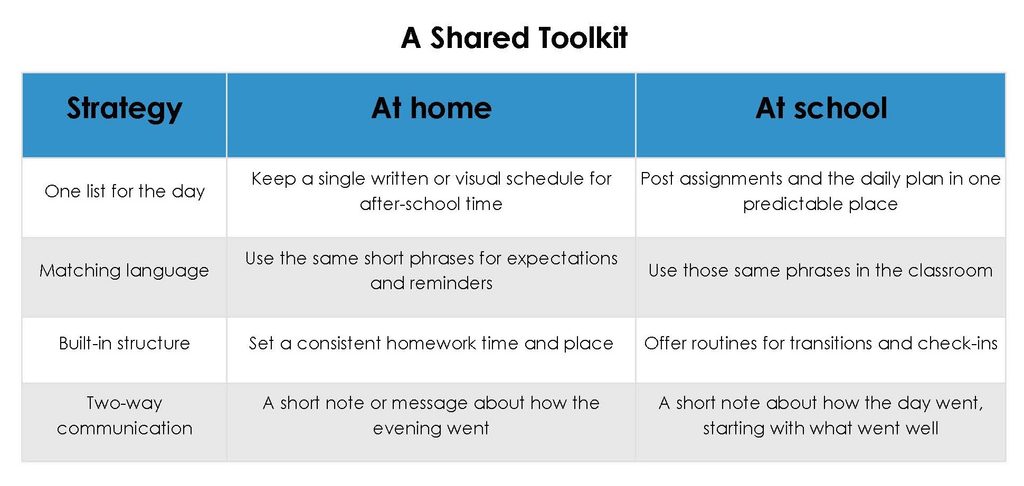
Effective collaboration centers on externalizing executive demands, moving information out of the child’s head and into the environment. Researchers describe this process as scaffolding: Adults establish routines, provide cues, and break large tasks into smaller steps, then gradually hand over the “executive” role as those skills grow (Center on the Developing Child at Harvard University, 2011). Structured routines and positive reinforcement are also among the best-supported classroom management practices. When families and educators use the same visual schedules, segmented tasks, routines, and reinforcement across settings, children have one system to learn instead of several. Family–school interventions that coordinate efforts in this way show positive effects on children’s social-behavioral competence.
If you’d like to keep exploring executive function, our website has additional resources, including videos you can watch at your own pace. Dr. Bertin, whose research informs much of this post, joins us for a workshop this winter. Details are coming soon.
References
Bertin, M. (2015). Mindful parenting for ADHD: A guide to cultivating calm, reducing stress, and helping children thrive, New Harbinger Publications, Inc.
Bertin, M. (2016, Fall). Executive function: What it is, why it matters. The Beacon, 1–3. The Windward School.
Best, J. R., & Miller, P. H. (2010). A developmental perspective on executive function. Child Development, 81(6), 1641–1660. https://doi.org/10.1111/j.1467-8624.2010.01499.
Center on the Developing Child at Harvard University. (2011). Building the brain’s “air traffic control” system: How early experiences shape the development of executive function (Working Paper No. 11). https://developingchild.harvard.edu/resources/working-paper/building-the-brains-air-traffic-control-system-how-early-experiences-shape-the-development-of-executive-function/
Diamond, A. (2013). Executive functions. Annual Review of Psychology, 64, 135–168. https://doi.org/10.1146/annurev-psych-113011-143750.
Miyake, A., Friedman, N. P., Emerson, M. J., Witzki, A. H., Howerter, A., & Wager, T. D. (2000). The unity and diversity of executive functions and their contributions to complex “frontal lobe” tasks: A latent variable analysis. Cognitive Psychology, 41(1), 49–100. https://doi.org/10.1006/cogp.1999.0734.
Sheridan, S. M., Smith, T. E., Moorman Kim, E., Beretvas, S. N., & Park, S. (2019). A meta-analysis of family-school interventions and children’s social-emotional functioning: Moderators and components of efficacy. Review of Educational Research, 89(2), 296–332. https://doi.org/10.3102/0034654318825437.
Simonsen, B., Fairbanks, S., Briesch, A., Myers, D., & Sugai, G. (2008). Evidence-based practices in classroom management: Considerations for research to practice. Education and Treatment of Children, 31(3), 351–380. https://doi.org/10.1353/etc.0.0007.
Smith, T. E., Sheridan, S. M., Kim, E. M., Park, S., & Beretvas, S. N. (2020). The effects of family-school partnership interventions on academic and social-emotional functioning: A meta-analysis exploring what works for whom. Educational Psychology Review, 32(2), 511–544. https://doi.org/10.1007/s10648-019-09509-w