Beyond the Diagnosis: Turning a Century of Reading Science Into Classroom Action
Every educator has met a student who defies explanation: curious, insightful, and full of potential, yet completely thrown when faced with text on a page. Before universal screening became commonplace…

Every educator has met a student who defies explanation: curious, insightful, and full of potential, yet completely thrown when faced with text on a page. Before universal screening became commonplace and the science of reading gained broader attention, these students were often misunderstood by teachers and families alike. However, the story of how we learned to see these children is an important shift in education. The 150-year journey from the designation “word blindness” to modern disability law tells the story of how neuroscience and advocacy ultimately reframed reading differences.
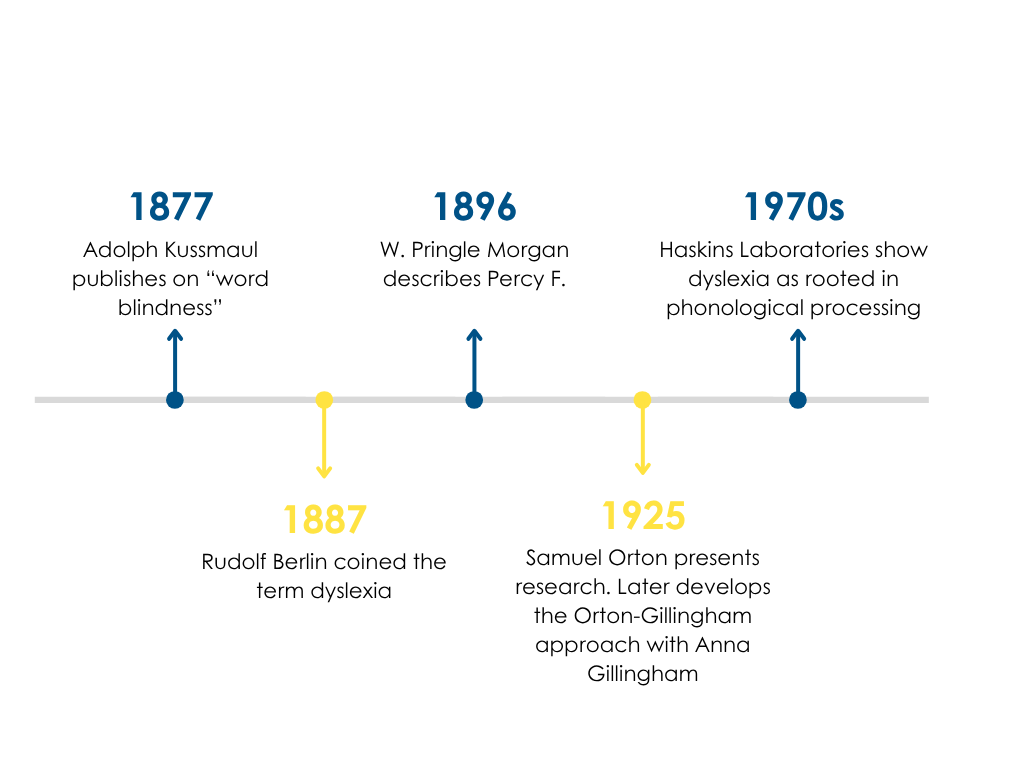
The story begins in 1877, when German physician Adolph Kussmaul studied adults that had sustained brain injuries and lost the ability to read, despite normal vision and intelligence; he coined the term wortblindheit (“word blindness”). Ten years later, ophthalmologist Rudolf Berlin introduced the term dyslexia (derived from Greek roots meaning “difficulty with words”) to describe underlying neurological visual-spatial processing issues. However, the term “word blindness” remained in common use. The true turning point arrived in 1896, when W. Pringle Morgan documented Percy F., a 14-year-old who excelled orally but could not read or write. Morgan identified it as “congenital word blindness,” shifting focus from adults who had lost an acquired skill to children struggling to develop it from birth. Together, these early findings established that reading difficulties are independent of general intelligence.
The Struggle for Recognition
Early discoveries about the nature of dyslexia, however, did not lead to general acceptance. Throughout much of the 20th century, children who struggled to read were routinely labeled lazy, careless, or less intelligent. While early medical case studies were groundbreaking, changing public perceptions proved to be far more difficult than publishing findings within medical literature.
One champion of targeted reading instruction, American neuropsychiatrist Samuel T. Orton, began publishing about dyslexia in the 1920s. Orton later collaborated with educator Anna Gillingham to develop a structured, multisensory phonics approach, the foundation of the Orton-Gillingham method widely known today.
For decades, dyslexia was related to visual changes, leading to interventions like colored overlays. That changed in the 1970s, when Isabelle Liberman and her colleagues at Haskins Laboratories proved that dyslexia isn’t a visual defect; rather, it’s a linguistic difference rooted in phonological processing, the brain’s ability to isolate and manipulate the individual sounds within spoken language.
Yet skepticism persisted. Some educators questioned whether dyslexia was a genuine neurological condition. Families frequently fought individual battles that eventually moved from classroom doors to state and federal legislatures.
Milestones in the Law
Propelled by the broader disability rights movement, the legal turning point arrived in the 1970s.
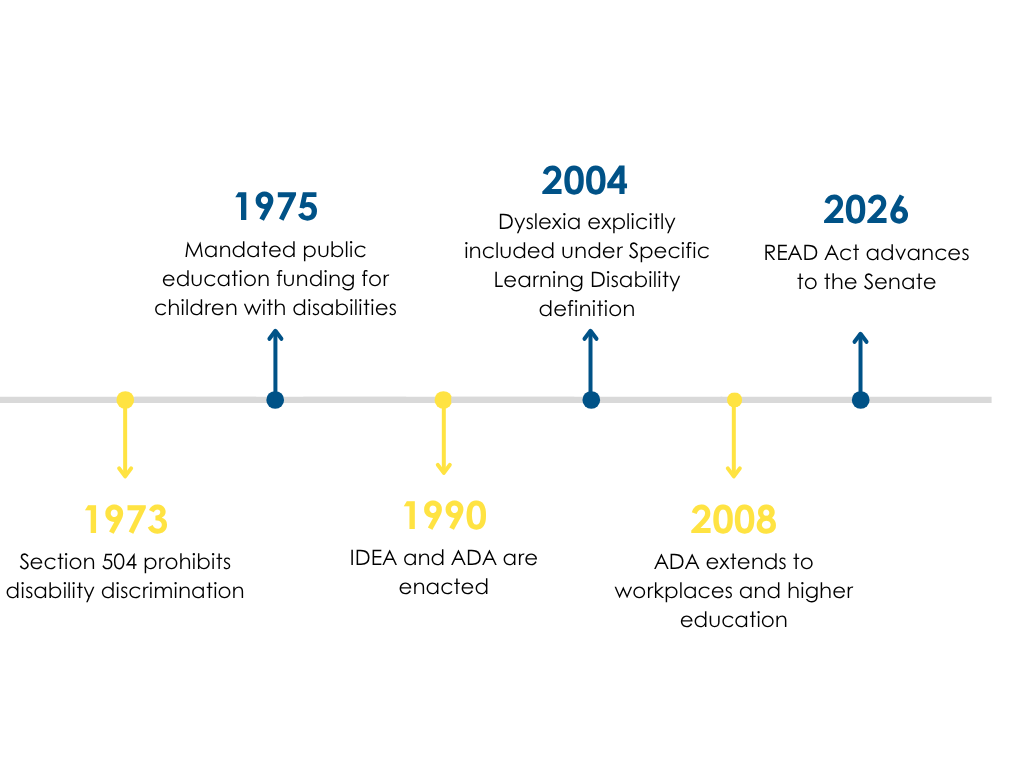
- Section 504 of the Rehabilitation Act (1973): Among the first federal civil rights legislation protecting individuals with disabilities. Today, students with dyslexia frequently utilize 504 Plans to secure accommodations such as tutoring, extra time on examinations, and accessible format materials.
- Education for All Handicapped Children Act (1975 / Public Law 94-142): At a time when many children with disabilities were receiving inadequate educational services or were excluded from public schools altogether, the law established protections to ensure their rights, meet their individual needs, and improve outcomes for them and their families.
- Individuals with Disabilities Education Act (IDEA, 1990 / 2004): The 1990 reauthorization of the Education for All Handicapped Children Act (EHA), which renamed the law the Individuals with Disabilities Education Act (IDEA), remains the cornerstone of modern special education in the United States. IDEA includes dyslexia as a condition that may qualify under the category of Specific Learning Disability (SLD). Students whose dyslexia substantially affects educational performance and who require specialized instruction may be eligible for an Individualized Education Program (IEP) and the protections of a Free Appropriate Public Education (FAPE).
- Americans with Disabilities Act (ADA, 1990 / ADAAA, 2008): Landmark U.S. civil rights law that prohibits discrimination against individuals with disabilities and ensures equal access to employment, public services, and public accommodations.
State-Level Dyslexia Legislation
Over the past decade, a nationwide movement led by many advocacy groups has driven states to consider specific dyslexia statutes requiring early universal screening, evidence-based structured literacy curricula, and specialized teacher training (Understood.org, 2023).
In 2026, two federal bills that would tie federal literacy funding to early dyslexia screening, bar the use of those funds for the “three-cueing” reading method, and give dyslexia its own classification under federal special education law advanced out of a U.S. Senate committee. Unfortunately, neither has become law.
Full Circle
A law on the books is only as effective as its implementation in the classroom. The shift from “word blindness” to federal statutes like IDEA and 504 proved that access is a civil right. True legislative advocacy doesn’t end when a bill passes; it requires ongoing policy work to secure funding. Real systemic change is driven by informed advocates who hold systems accountable to the science. Equal access to effective instruction shouldn’t depend on a student’s zip code or a district’s curriculum budget. State policy must guarantee scientifically validated literacy instruction for every classroom.
While legislation is important, lasting reform comes from teacher training and parent advocacy. If a child is experiencing difficulty acquiring literacy skills, early action is essential. Simple reading screenings, for example, can identify challenges with phonological awareness, decoding, and rapid naming, and they should be conducted with students early and often. It took more than 100 years to change how the law views dyslexia. Educators and families must work together to support every child.
References
Congressional Research Service. (2024). The rights of students with disabilities under the IDEA, Section 504, and the ADA (CRS Report No. R48068). https://www.congress.gov/crs-product/R48068
Education Week. (2026, July). Federal “Science of Reading” bill advances. https://www.edweek.org/teaching-learning/federal-science-of-reading-bill-advances/2026/07
Hinshelwood, J. (1917). Congenital word-blindness. H.K. Lewis & Co. Ltd.
International Dyslexia Association, Georgia Branch. (2026). Laws and local policies. https://ga.dyslexiaida.org/laws-and-local-policies/
Kirby, P. (2018). A brief history of dyslexia. The Psychologist, 31, 32–35. https://www.bps.org.uk/psychologist/brief-history-dyslexia
Kirby, P. (2020). A brief history of dyslexia. The History of Dyslexia Project, University of Oxford. https://dyslexiahistory.site.ox.ac.uk/brief-history-dyslexia
Kussmaul, A. (1877). Disturbances of speech. In H. von Ziemssen (Ed.), Cyclopaedia of the Practice of Medicine (Vol. 14, pp. 581–875). William Wood & Co.
Liberman, I. Y. (1971). Basic research in speech and lateralization of language: Some implications for reading disability. Bulletin of the Orton Society, 21(1), 71–87.
Morgan, W. P. (1896). A case of congenital word blindness. British Medical Journal, 2(1871), 1378.
Orton, S. T. (1925). “Word-blindness” in school children. Archives of Neurology & Psychiatry, 14(5), 581–615.
21st Century Dyslexia Act, H.R. 5769, 119th Cong. (2025). https://www.congress.gov/bill/119th-congress/house-bill/5769
READ Act, S. 4689, 119th Cong. (2026). https://www.congress.gov/bill/119th-congress/senate-bill/4689/text
Read Naturally. (2021). The birth of dyslexia: The early brain science of 19th-century medicine. Read Naturally Blog. https://www.readnaturally.com/about-us/blog/the-birth-of-dyslexia-the-early-brain-science-of-19th-century-medicine
Understood.org. (2023). Dyslexia laws: What they are and how they work. Understood for All, Inc. https://www.understood.org/en/articles/dyslexia-laws-what-they-are-and-how-they-work
Yale Center for Dyslexia & Creativity. (2020). Understanding the law: ADA, IDEA, and Section 504. Yale University. https://dyslexia.yale.edu/resources/accommodations/understanding-the-law